

BMS

Photographer: Michael Fousert via: Unsplash
Electric vehicles have become the most important development trend in the current automotive industry, and the charging time and cruising range of batteries are the key to whether consumers are willing to purchase electric vehicles. The battery management system (BMS) of electric vehicles has also become a key module in the development of electric vehicles. . This article will introduce the development direction of BMS, the related products launched by Infineon (Infineon), and the functional characteristics of the BMS reference design launched by Arrow Electronics.
The battery management system is the key device for battery charging and discharging
BMS is an electronic control circuit that monitors and regulates battery charging and discharging. It is an electronic control circuit that can collect information about battery status, including detection of battery type, voltage, temperature, capacity, state of charge (SoC), state of health (SoH), power consumption, remaining Operating hours, charge cycles, and more characteristic information are communicated to the host system and the electronics that perform battery management.
The BMS of lithium-ion batteries needs to monitor the voltage and temperature of the battery, and perform key functions such as battery balancing. Accurate battery voltage measurement will also ensure that the battery can operate under safe operating conditions to meet functional safety requirements. Due to certain battery chemistries charging may become unstable after overvoltage, undervoltage or overcurrent. Thus, the BMS ensures that the cells in the system are always operating within the state of aging (SOA) for a given chemistry, provides voltage and temperature measurements for each cell through external resistors (NTC), cell balancing, and integrates the measurements and diagnostics Information is passed to the main microcontroller.
The task of the BMS is to ensure optimal utilization of the remaining energy in the battery. In order to avoid improper charging and discharging of the battery, the BMS will protect the battery from deep discharge, overvoltage, which is caused by extremely fast charging and high discharge current. result. In the case of a multi-cell battery, the BMS also provides a cell balancing function to manage different cells so that they have the same charging and discharging requirements.
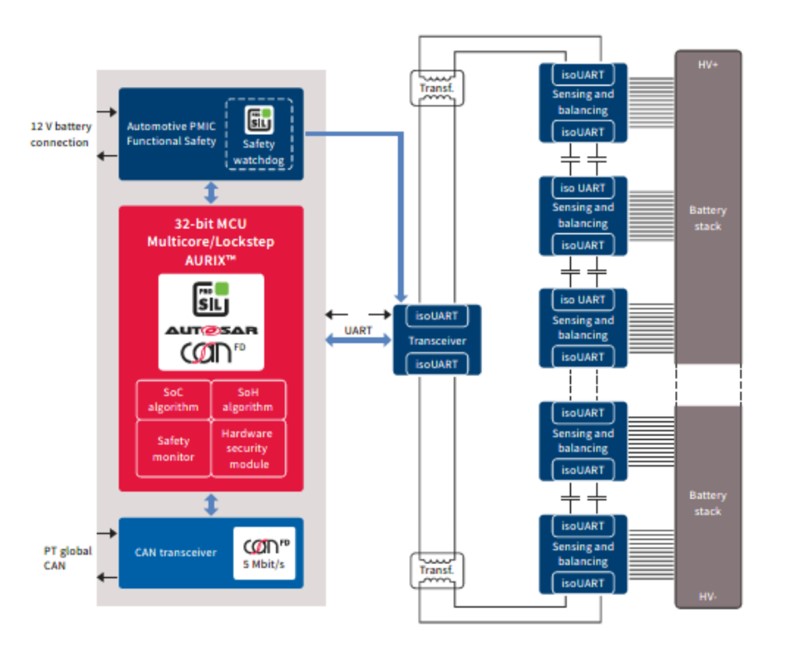
Battery Management System Improves Safety and Functionality of Electric Vehicles
BMSs can be used to monitor and control batteries used in many applications, and wherever they are used, cell balancing ICs are a critical safety and functionality key factor. BMS can be widely used in the field of electric vehicles, including electric vehicles, off-road vehicles such as trucks and golf carts, and machinery such as forklifts. BMS can also use batteries for backup power such as power grids and industrial power infrastructure, including cell phone towers, air conditioning substations, Internet infrastructure, aviation support systems, tower communication and weather stations. Additionally, there are a growing number of consumer products, such as e-bikes and other recreational vehicles, that are battery powered and rely on BMS for efficient and safe use.
Infineon provides optimized battery management solutions for battery monitoring and balancing applications. Battery management ICs, also known as cell balancing ICs or battery monitoring ICs, are critical to the overall health of many automotive systems.
Infineon's battery management ICs can be used in safety-related applications, and automotive BMS solutions can meet ASIL-D safety requirements and are ISO26262 compliant. Infineon's battery management ICs can be used with AURIX™ series microcontrollers and functional safety PMICs to provide a complete solution for voltage and temperature sensing, balancing and communication across various battery solutions.

Battery Monitoring Device Improves Efficiency and Safety of Battery Operation
TLE9012DQU launched by Infineon is a multi-channel battery monitoring and balancing IC designed for lithium-ion battery packs, suitable for various types of MHEV (mild hybrid electric vehicles), HEV (gasoline electric hybrid electric vehicles) in the automotive field , PHEV (plug-in hybrid electric vehicle) and BEV (bare electric vehicle), many applications of electric vehicles, industrial (energy storage system) and consumer (ie electric bicycle BMS, home energy storage, etc.) applications. The TLE9012DQU implements four main functions including battery voltage measurement, temperature measurement, battery balancing and isolated communication with the main battery controller. In addition, the TLE9012DQU provides the necessary diagnostic tools to ensure proper operation, thus ensuring the safety of those around the controlled battery.
TLE9012DQU can monitor the voltage of up to 12 series-connected batteries, supports hot swapping, each unit has a dedicated 16-bit delta-sigma ADC with optional measurement mode, supports SoC (state of charge) and SoH (state of health) calculation High-accuracy measurements, integrated strain sensors with digital compensation algorithms and temperature-compensated measurements, and secondary ADCs with the same averaging filter characteristics as advanced end-to-end safety mechanisms, and five temperature sensors for external NTC thermistors The measurement channel, with an internal temperature sensor, integrates an equalization switch to allow equalization currents up to 200 mA.
TLE9012DQU supports differential stable serial 2 Mbit/s communication interface, additional four GPIO pins can be used to connect external EEPROM, internal loop routines can trigger most diagnostic mechanisms, support automatic equalization over-current and under-current detection scheme, automatic Open load and open circuit detection scheme, automatic NTC measurement unit monitoring scheme, support end-to-end CRC safety iso UART/UART communication, emergency communication mode, it is an ISO 26262 safety component that meets ASIL D safety requirements, and is a green product that meets RoHS .
TLE9012DQU has best-in-class application robustness, with Infineon technology and device architecture to ensure the best performance under noise, with the lowest system cost, in a small package (TQFP-48) and with high functional integration, enabling a compact external BOM.
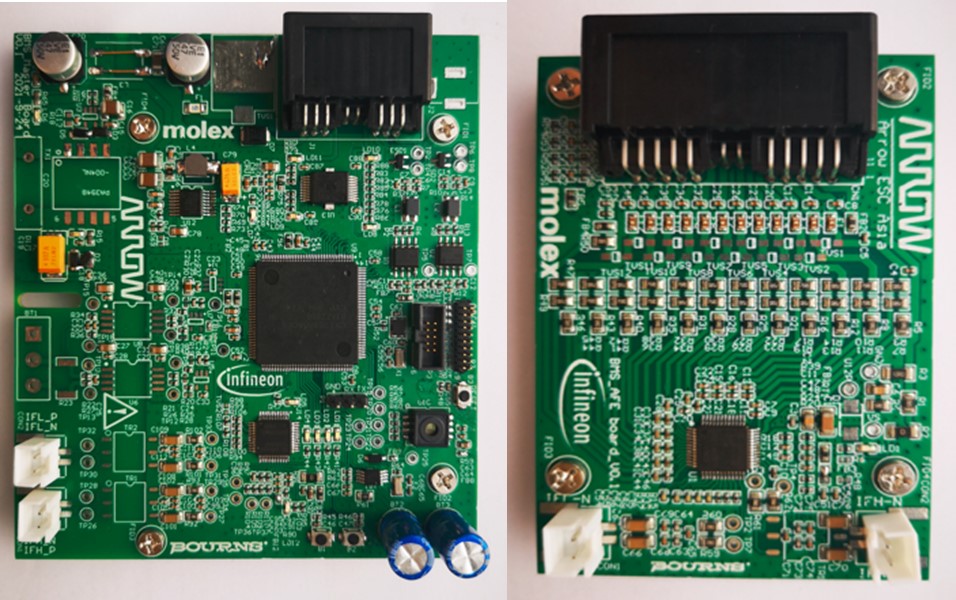
Full-featured battery management system reference design
Arrow Electronics has introduced a battery management system (BMS) reference design for electric vehicle applications. The BMS is an electronic control circuit that monitors and regulates the charging and discharging of batteries. The reference design consists of Infineon's powerful automotive-grade Traveo II MCU CYT2B97, AFE TLE9012D and transceiver TLE9015D. TLE9012DQU realizes the four functions of battery voltage measurement, temperature measurement, battery balancing and isolated communication, and TLE9015D acts as a transceiver to connect TLE9012DQU and MCU main battery controller. Additionally, the solution integrates pressure sensing, RTC, and system voltage and current sensing.
This BMS reference design has the advantages of low cost and optimized size, reduced software workload, and faster time to market. It can balance and monitor up to 12 batteries in series. It has 12 channels of dedicated 16-bit delta-sigma ADC battery voltage monitor with an accuracy of approx. It is 5.8mV, adopts 7μS fast synchronous battery voltage sampling of 2Mbit/s iso-UART, has up to 200mA internal current balance and 5-channel temperature sensor, can retain pressure sensor and external RTC, and supports system voltage and current sensing.
The BMS reference design uses Infineon's CYT2B97CACES, TLE9012DQU, TLE9015DQU, TLE9014SH, TLE9351VSJ, KP256TMA, S6BP201A1A1AST2B20A, and ADI's AD8601WARTZ, TL6654AHS6-1.25#WTRMPBF, LT8301 ES5#WTRMPBF, Si8931D-IS4, Si8921BD-IS4 from Skyworks, SM91502ALA from Bourns, SRP3020TA-2R2M, CDSOT23-T24CAN, SRF3225TAFD-101Y, SRF9045A-701Y, SM8S24CA-Q, and Molex’s 348260160, 348240164, 348260240, 348240244, 5023520200, 50235 10200 and other core chips can be used in electric vehicle applications such as HEV, PHEV, and BEV .
The battery management of electric vehicles plays a key role in the safety and performance of vehicles, which can greatly improve the safety and charging and discharging efficiency of electric vehicles, and will help more consumers switch from fuel vehicles to electric vehicles , to further expand the market share of electric vehicles. The BMS solution launched by Infineon and the BMS reference design launched by Arrow Electronics will help related manufacturers to develop products with better performance, and can also greatly increase the speed of product development. It is worth your in-depth understanding and adoption.
by arrowsolution.com
Next:the last one

Immediate access solution
To provide one-stop procurement services and solutions for electronic components and semiconductor components